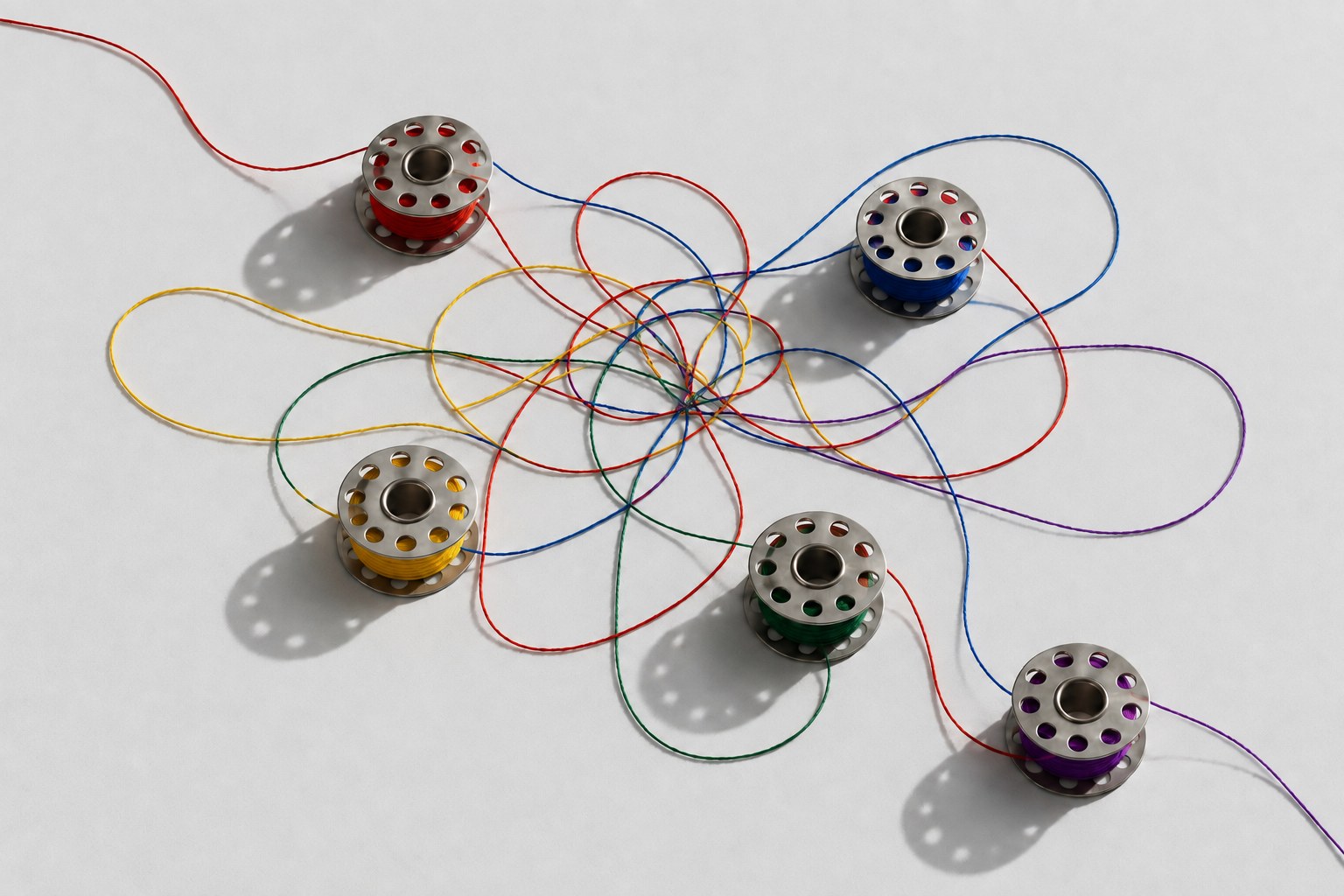
The hardest view is often the one from inside. You live close to the work, carry its history, and understand connections long before those connections have words.
That proximity creates instinct and momentum. It also makes it harder to separate what the business means to you from what another person can see.
Proximity hides the pattern
The product, story, customer conversations, future plans, frustrations, references, and personal instincts already belong to one internal picture. From inside, the connections feel natural.
Asked to explain it, a founder may offer ten true ideas with no visible hierarchy between them. The missing piece is the centre that shows how they belong together.
The business can feel personal
A business can carry years of effort, personal taste, ambition, and the kind of work its founder wants to put into the world. A question about the brand can touch all of that.
Feedback on a website may feel like a judgement of your taste. Narrowing an offer may feel like leaving part of yourself out. Changing a direction may mean letting go of something you once worked hard to become.
That makes some brand decisions emotionally difficult, even when the practical reasoning is clear.
It helps to separate three questions:
- What matters to me personally?
- What gives this particular business its character?
- What does the business need to deliver for its customers?
The answers will overlap. Seeing where they overlap makes it easier to decide what belongs in the brand.
The founder’s character can be one of its richest sources of distinction. The work is to understand which qualities give the business a meaningful direction, and how those qualities can take a form others can experience.
Context stays in the founder’s head
Every decision arrives with a backstory: why one audience matters more, why the offer evolved, why a familiar word feels wrong, why a small product detail represents a larger belief.
Public expression often carries the conclusion while the reasoning stays with one person. The result can look complete and still be hard to understand.
Everything feels important
Notes, saved images, customer comments, objections, ambitions, and strong opinions all contain useful material. Their volume makes selection difficult.
Strategy gives the material a role:
- Some ideas define the offer.
- Some reveal a point of view.
- Some belong to a future product.
- Some set the tone.
It also decides what can wait.
Memory completes the page
Founders read the website with the intended meaning already present. The mind supplies missing connections, examples, and emotional weight. A visitor meets the same page without that stored knowledge.
This is why live sales conversations can feel strong while the website feels vague. In the room, the missing context returns naturally.
Taste arrives before language
Many founders recognise the right direction before they can explain it. They know which reference feels alive, which phrase sounds generic, and which visual choice loses something essential.
Instinct is valuable source material. The work is to find its pattern, connect it to the business, and turn it into principles others can apply.
Growth moves faster than expression
Sometimes the difficulty comes from change. The offer has matured, the audience has shifted, or the team has grown while the public identity still represents an earlier stage.
The old version may look acceptable and no longer feel true. Realignment begins by naming what the business has already become.
In practice: Galya Fedotova
Galya Fedotova came to ISEENOW with an established reputation across fashion shows in Milan and Paris, the Cannes Film Festival, and years of work with private clients. Her next stage included plans for a brush line and beauty hub. The brand needed one expression that could connect this experience with her personal aesthetic and the philosophy behind her work.
“It was important to find the visual style that truly reflects the aesthetic and idea of my brand.”
Galya Fedotova, Founder and Makeup Artist
We built the identity around the relationship between precise technique and creative inspiration. Galya’s name and portfolio became the centre of a restrained visual system, while the brand language and key slogans gave form to the philosophy behind her work. The website, printed materials, and overall concept were brought into one cohesive image with room for future products and expansion.
Distance needs a method
Useful distance allows the founder’s perspective to be examined with care. Personal investment remains part of the work, alongside product choices, audience needs, and market context.
The process follows a simple sequence:
- Examine repeated ideas, tensions, product choices, audience needs, visual references, and ambitions.
- Identify an idea strong enough to organise the rest.
- Use it to guide positioning, narrative, voice, identity, and future decisions.
Make the inside visible
The founder will always hold a deeply personal relationship with the business. A defined core gives that relationship a useful form: a direction that preserves what matters and leaves room for the business to develop.
The moment everything connects often feels like recognition: the business you have been building is finally visible from the outside.
The Brand Core Session is a focused two-hour session for finding that centre. Bring the notes, references, doubts, recurring phrases, and unfinished ideas. We find the pattern and shape a direction the business can grow from.
Explore the Brand Core Session →